SWIPEBY vs SpotHopper
TL;DR. SpotHopper is, at its core, a restaurant website design kit plus a one-time on-site photographer/videographer service, with marketing automation tools added around it. Three things any operator should know before signing: (1) Three months to go live — per SpotHopper's own onboarding schedule. (2) The restaurant never owns the photos and videos — SpotHopper keeps them; reclaiming ownership at cancellation costs $3,000 in year one, $2,000 in year two. (3) BBB-documented contract auto-renewal and cancellation friction, including settlement terms that require waiving the right to file state-agency complaints or post negative reviews. The website kit and photo shoot are real value. The rest is undifferentiated — and the marketing automation is starved by the fact that SpotHopper's own online ordering is rarely used by customers, so the email/SMS engine runs on a thin website-signup list rather than rich order data.
What SpotHopper actually is
Strip the marketing language and SpotHopper is two things: a website design kit with templated builds, and a professional photographer/videographer service that visits the restaurant once. Everything else — email automation, SMS, social posting, review requests, reputation management — is similar to what every other platform in the category offers, built around those two anchors.
That's a defensible category if those two specific things are what an operator is shopping for. It's not what most operators think they're buying when they hear "AI-powered marketing and growth platform."
Three things any operator should know before signing
1. Three months to go live. Not a few weeks. Per SpotHopper's own onboarding schedule, the timeline runs roughly: kickoff (ASAP) → domain login (ASAP) → photo/video shoot (month 1) → website build (month 2, up to 100 hours of work) → publish (month 3). If feedback isn't received within 30 days, SpotHopper auto-publishes the draft.
2. The restaurant never owns the photos or videos. Per SpotHopper's contract terms, SpotHopper retains ownership of all photos and videos produced for the restaurant. To reclaim ownership at cancellation, the operator must pay $3,000 within the first 12 months, or $2,000 between months 12 and 24. Without that payment, the photos and videos of the restaurant cannot be used after canceling SpotHopper.
3. Contract auto-renewal and cancellation friction is BBB-documented. The Better Business Bureau profile (West Allis, WI) shows a recurring pattern of cancellation requests not being honored, post-cancellation billing, salesperson disappearing after sign-up, and settlement terms requiring customers to waive the right to file state-agency complaints or post negative reviews.
The 3-month go-live, in SpotHopper's own words
SpotHopper publishes its own onboarding schedule. The screenshot below is from that document. The six milestones cover three full months from initial kickoff to going live:
SpotHopper's official onboarding schedule
From SpotHopper's onboarding documentation. Operator-shared; reproducible by asking any SpotHopper sales rep for the schedule.
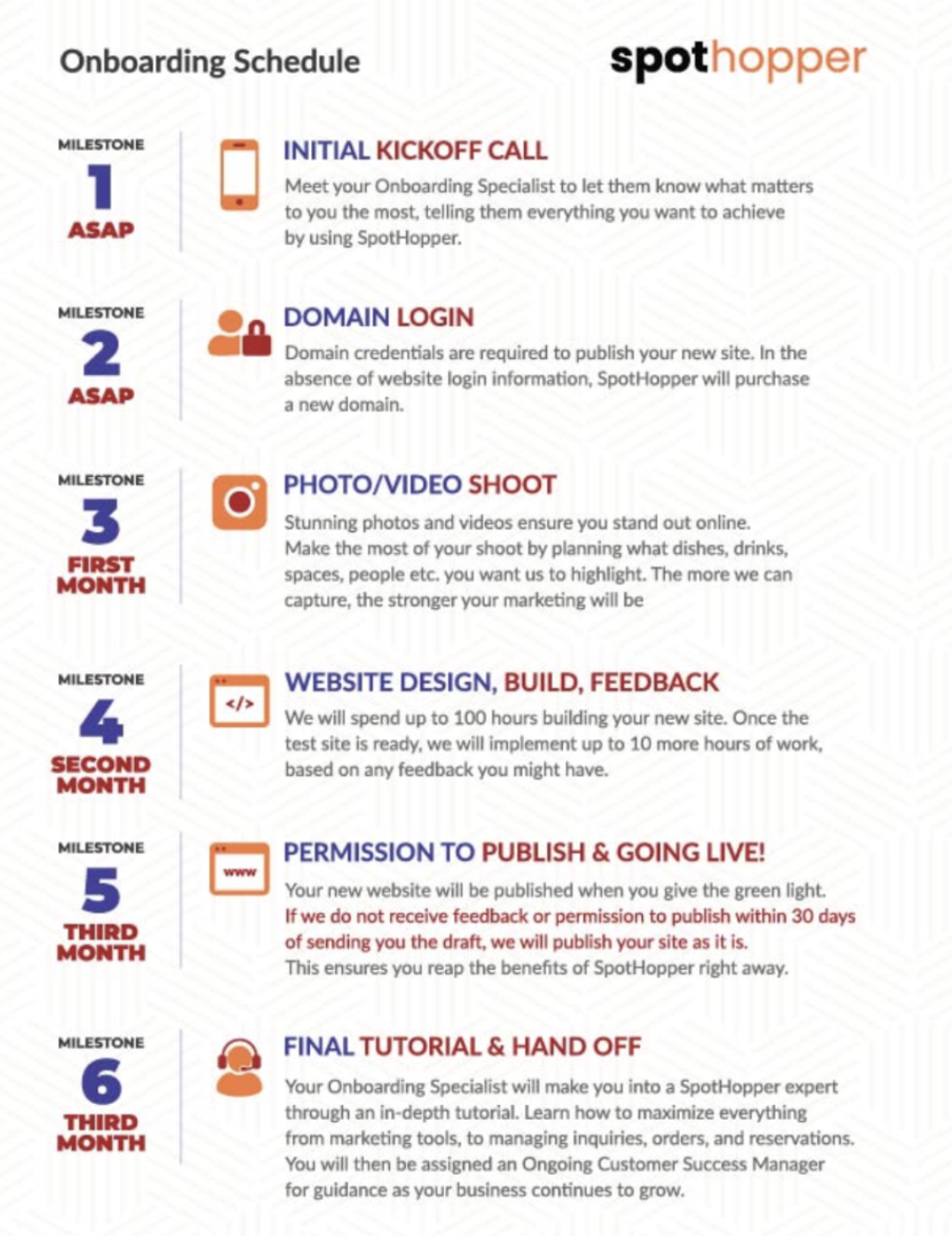
- Milestones 1–2 (ASAP): kickoff call + domain login
- Milestone 3 (month 1): photo/video shoot
- Milestone 4 (month 2): website build — "up to 100 hours" + 10 hours of feedback
- Milestone 5 (month 3): permission-to-publish. Auto-publishes after 30 days if no feedback received.
- Milestone 6 (month 3): tutorial and hand-off to ongoing Customer Success Manager
By comparison, SWIPEBY typically takes a few weeks to go live — and the entire marketing stack (AI phone, review/reputation, agentic social, email/SMS, ordering) is operating during that ramp, not waiting on a website publish.
For an operator who's losing customers to competitors today, three months is a lot of revenue waiting on a templated website to be built by hand.
The photo and video ownership trap
This is the single most consequential thing in SpotHopper's contract — and the part operators least expect.
SpotHopper sends a professional photographer and videographer to the restaurant during onboarding to capture photos and video of the food, the space, and the team. The photo shoot is real human work and the resulting assets look great. The catch is in the contract:
SpotHopper retains ownership of all photos and videos it produces or commissions for the restaurant. The restaurant is licensed to use them only as long as the SpotHopper subscription is active. Per third-party analysis of the SpotHopper contract terms (Sociavore comparison page): at cancellation, the licensing stops — and to reclaim the right to use the photos and videos of their own restaurant, the operator must reportedly pay SpotHopper:
- $3,000 if the operator wants to reclaim ownership within the first 12 months of the subscription
- $2,000 if reclaimed between months 12 and 24
- (After 24 months, terms vary by contract — pricing on request)
Without that payment, per the same analysis, the photos and videos of the restaurant — the menu items, the dining room, the staff portraits, the chef at work — cannot be used by the restaurant after canceling SpotHopper. Not on Instagram. Not on the new website the restaurant builds elsewhere. Not in print materials. Not anywhere. Operators should verify the current ownership and reclamation terms with SpotHopper directly before signing — the figures cited here come from one third-party analysis and the contract may have been updated.
For comparison: SWIPEBY's content production is AI-generated and ongoing. The restaurant owns and can use the assets without an ownership-reclamation fee. There is no "hostage" mechanism in the contract.
Contract auto-renewal and cancellation friction (BBB-documented)
Recurring themes from SpotHopper's Better Business Bureau complaints page (West Allis, Wisconsin office):
- Auto-renewal disguised as month-to-month. Customers reported being locked into another year-long contract after completing their initial 1-year contract, having believed they had renewed for a month-to-month arrangement.
- Cancellation requests not honored. One customer submitted multiple written cancellation requests and received written confirmation of termination dated March 4, 2025, only to be charged again after the cancellation acknowledgment.
- Post-cancellation billing. Customers reported continuing to make payments on contracts even after discontinuing service, and being repeatedly billed for additional time after canceling at the end of the contract period.
- Salesperson disappears post-signature. Customers reported that after signing the contract, salespeople would disappear and services promised during the sales conversation did not materialize. This maps cleanly to Glassdoor reviews from former SpotHopper sales reps describing 12-month commission clawback structures that incentivize close-fast, hand-off-and-move-on behavior.
- Settlement terms require waiving rights to complain. The company has offered to terminate contracts and stop billing only if customers accept settlement terms that require refraining from filing complaints with state agencies or posting negative reviews. No refunds granted for early release.
None of this is in the marketing materials, but it's all in the BBB record.
Why SpotHopper's marketing is weaker than it looks: the data problem
This is the structural issue underneath the feature list. Modern restaurant marketing is only as good as the data flowing into it. The platforms with the strongest marketing engines are the ones with the most first-party order data:
- SWIPEBY: every online order through the platform feeds rich data — who, what, when, how much, frequency, lapse — into the AI agents that run email, SMS, social, and review-request campaigns. The marketing engine is fed by the ordering engine.
- Toast and Owner.com: similar logic — their marketing modules are powered by the order data from their own POS/ordering platforms.
- SpotHopper: SpotHopper has its own online ordering, but operator and reviewer reports consistently note it is rarely used by customers. Customers prefer ordering through DoorDash, Uber Eats, or Google instead. Which means SpotHopper's email and SMS automation runs on a thin pool of customers who manually entered an email signup on the website — closer to a Mailchimp list than an order-data-driven CRM.
The downstream consequences show up in reviews: "1/3 to 1/2 of email lists not going out, with SpotHopper maintaining there is nothing they can do." When the marketing automation isn't connected to real, fresh customer behavior, the campaigns it sends are guesses — and the delivery infrastructure isn't being stress-tested against real usage.
This is also a fair critique of PopMenu's marketing for the same reason: when the platform's own ordering doesn't capture real customer behavior, the marketing engine is starved upstream of the data it needs to be smart.
Quality of the rest of the features: okay, undifferentiated
Outside the website kit and the photographer service, SpotHopper's modules look like everyone else's: email campaigns, SMS, social posting, review request flows, reputation monitoring. The feature names match what Toast IQ Grow, PopMenu Premier, and Owner.com offer — and per G2 reviewer feedback, the execution is rated "repetitive and misaligned" on AI-generated content quality. Functional. Not a moat.
Where SpotHopper genuinely wins
Honest acknowledgments — SpotHopper has real strengths:
The on-site photo and video shoot is real, human work. A professional photographer/videographer visiting the restaurant produces assets at a quality level that AI-generated content doesn't fully match in 2026. For restaurants that specifically want professional, on-brand, human-shot photos and don't have the time or skill to produce them themselves, the photo shoot is genuine value — provided the operator understands the ownership terms (see above).
Templated website builds look professional. The website kit produces clean, on-brand sites. The 100-hour build is human craft.
Scale. 18,000–19,000 restaurants per SpotHopper's own claims is the largest customer base of the SMB-focused marketing platforms in this comparison set. There are a lot of operators who chose SpotHopper and are reasonably happy.
Customer support praised in initial reviews. The pre-sales and onboarding experience reads positively in published reviews. (The complaint pattern around post-sale responsiveness and contract issues is the honest balance.)
Tools vs autonomous AI marketing agency
SpotHopper's marketing automation runs on operator-configured templates and a thin email-signup list. SWIPEBY operates as an autonomous AI marketing agency where agents build, send, monitor, and re-optimize across email, SMS, social (with AI photo and video generation), review responses, phone answering, and ads continuously — fed by the rich order data flowing through SWIPEBY's actively-used online ordering.
At a glance
| SWIPEBY | SpotHopper | |
|---|---|---|
| Category | Autonomous AI marketing agency (POS-agnostic; native Toast integration) | Website design kit + on-site photographer service, with bolted-on marketing tools |
| Time to go live | A few weeks | 3 months (per SpotHopper's own onboarding doc); auto-publishes after 30 days if no feedback |
| Photo/video ownership | Operator owns assets; AI-generated photos and videos are theirs to use anywhere | SpotHopper retains ownership; reclaim cost: $3,000 in year 1, $2,000 in year 2 |
| Photo/video model | Ongoing AI-generated photos + video of menu items; continuous content pipeline | One-time on-site human photographer visit during onboarding |
| Marketing data source | Rich first-party order data from native, actively-used online ordering | Website email-signups (their own online ordering is rarely used by customers, per reviews) |
| Contract | Month-to-month available | Year-long; auto-renewal pattern documented in BBB complaints; settlement requires waiving complaint rights |
| Pricing | Bundled in standard tier — pricing on request | Not published — sales-gated quote; third-party reports cite $249–$600/month range |
| POS integrations | Native Toast; supports most major POS | No POS integrations listed on SpotHopper's own FAQ page |
| AI phone answering | Native, core module | Not advertised as a native module |
| Customer base | SMB independents and small chains; growing | 18,000–19,000 restaurants per SpotHopper's own claims |
| Email delivery | Standard infrastructure, no widespread delivery complaints | Reviewer reports of 1/3–1/2 of email lists not going out |
| Sales culture | — | Glassdoor: 20+ meetings/50+ calls per day quotas, 12-month commission clawback; BBB: post-sale salesperson disappears |
What SpotHopper operators report (sourced from BBB and reviews)
Three recurring themes summarized from operator-side review and complaint patterns:
- Post-signature responsiveness drops. A recurring theme across SpotHopper's BBB complaint filings: salespeople become unresponsive after the contract is signed, and services promised during the sales conversation reportedly do not materialize.
- Email delivery reliability issues. Multiple operator reviews describe a meaningful fraction of email campaigns (cited variably between roughly one-third and one-half) failing to send, with SpotHopper reportedly indicating limited recourse. Sources: operator reviews on SlashDot and G2.
- AI-generated content quality. G2 reviewers have characterized SpotHopper's AI-generated content as repetitive and not always well-aligned with brand voice — a recurring theme across the review base rather than a single quote. See the G2 SpotHopper pros & cons page.
By contrast, from SWIPEBY's reviews:
"Swipeby has taken over social media, all my reviews, marketing, phone calls, and my website and online ordering. Because it is all AI, I don't have to even set up anything or interact with it much. I just see the results."
— G2 verified reviewer in Hospitality (May 2026). Source
Bottom line
SpotHopper is a website design kit and a photographer service with a name and marketing language that suggest more. The website is real; the photo shoot is real; the rest is similar to what every other platform in the category offers, run on a thinner data stream than competitors who own a meaningful share of the actual order flow.
The three structural concerns — 3 months to go live, a photo-ownership trap that costs $2,000–$3,000 to escape, and a BBB-documented pattern of contract auto-renewal and cancellation friction with settlement terms that require waiving complaint rights — are the things an operator needs to weigh before signing. The shiny things are real. The contract is the catch.
SWIPEBY is the opposite stack: autonomous AI marketing agency, weeks (not months) to go live, ongoing AI photo and video the operator owns, native integration with the POS systems operators actually use, and no asset-hostage clause. The trade-off is no on-site human photographer — if that one specific service is the deciding factor, that's a real choice. For everything else, the structural picture favors SWIPEBY.
Frequently asked
What is SpotHopper, really?
A restaurant website design kit plus a one-time on-site photographer/videographer service, with marketing automation tools (email, SMS, social posting, review requests) added around it. The website kit and the photo shoot are the value-adds. The rest is undifferentiated.
How long does SpotHopper take to go live?
Approximately three months per their own onboarding schedule. Auto-publishes after 30 days if the operator doesn't provide feedback. SWIPEBY typically goes live in a few weeks.
Does the restaurant own the photos and videos SpotHopper produces?
No. SpotHopper retains ownership. To reclaim ownership at cancellation: $3,000 in the first 12 months, $2,000 in months 12–24. Without that payment, the photos and videos of the restaurant cannot be used after canceling SpotHopper.
What contract and cancellation issues are documented?
Per the BBB complaint record: auto-renewal into another year-long contract after the initial term, written cancellation requests not honored, post-cancellation billing, salespeople disappearing after sign-up, and settlement terms requiring waiver of state-agency complaints and negative reviews.
Why does SpotHopper's online ordering being unused matter?
Modern restaurant marketing automation runs on customer order data. Platforms with native, well-used online ordering (SWIPEBY, Toast, Owner.com) capture rich first-party data — who, what, when, how often — that feeds smart triggers and personalization. SpotHopper's online ordering is rarely used per reviewer reports, so its email/SMS automation runs on a thin website-signup list rather than real order behavior. The marketing engine is starved of the data that makes it smart.
What does SpotHopper genuinely do well?
The on-site photographer/videographer visit is real human work and produces real assets (with the ownership caveat). The templated website kit looks professional. Scale: 18,000–19,000 restaurants. Pre-sales support is praised in initial reviews. PopMenu-style interactive menu, AI Phone, and review/reputation depth are not where SpotHopper competes.
How is SWIPEBY's marketing model different from SpotHopper's?
SpotHopper's marketing runs on templated campaigns fed by website email-signups. SWIPEBY operates as an autonomous AI marketing agency — agents build, send, monitor, and re-optimize across email, SMS, social (with AI photo and video generation), review responses, and phone answering continuously, fed by the rich order data from SWIPEBY's actively-used online ordering. Tools vs an always-on AI marketing team built on real data.
Disclosure. This page is a comparison aggregator. SWIPEBY, SpotHopper, and any other trademarks belong to their respective owners. Not affiliated with SpotHopper. SpotHopper capability, contract, and complaint claims are sourced from SpotHopper's own published onboarding documentation, third-party contract-term analysis, Better Business Bureau filings (West Allis, WI office), Glassdoor reviews, and operator review aggregators as of . Verify contract terms with SpotHopper directly before signing.